In the field of anti-aging and longevity technology, NAD+ has become a superstar molecule in recent years, often referred to as the “key to anti-aging.” This article will provide a comprehensive overview of NAD+, from its basic science to practical applications.

What is NAD+?

NAD+ (Nicotinamide Adenine Dinucleotide) is a crucial coenzyme found in every cell of your body. It first appeared on the scientific stage in 1904 as the first coenzyme ever discovered.

Simply put, NAD+ is a hardworking “electron shuttle.” It cycles between an oxidized state (NAD+) and a reduced state (NADH), transferring electrons between molecules. This makes it the central hub for converting the food you eat into the energy (ATP) your cells need to function.

More importantly, recent research has revealed that NAD+ is also the sole substrate for several critical enzymes, directly participating in DNA repair and gene expression. Your NAD+ level is directly linked to how your cells age.

How Do Cells Produce NAD⁺?

Cells maintain their NAD+ levels through two main pathways:

The de novo synthesis pathway primarily occurs in the liver and kidneys. It uses an essential amino acid—tryptophan—to generate NAD+ through a series of enzymatic reactions.

The salvage pathway is the primary and more efficient method for most cells. It recycles existing NAD+ precursors, which are derivatives of vitamin B3, including nicotinamide, nicotinic acid, and nicotinamide riboside.

This pathway has a crucial rate-limiting enzyme called NAMPT. A 2025 study in Molecular Cell revealed that NAMPT isn’t just a synthetic enzyme; it’s also an “energy sensor.” When cellular energy is low, AMP binds to and inhibits NAMPT, coordinating the two core pathways of ATP and NAD+.

Which Enzymes Consume NAD+?

Several key enzymes act as the primary “engines” that consume NAD+:

PARP is the “first responder” for DNA damage repair. When DNA is damaged, PARP is activated and uses NAD+ for repairs. However, excessive DNA damage can over-activate PARP, rapidly depleting NAD+.

Sirtuins are a class of deacetylases known as “longevity proteins.” They regulate mitochondrial function, inflammation, and metabolic health. Their activity is strictly dependent on NAD+ levels.

CD38 and SARM1: CD38 uses NAD+ to generate signaling molecules involved in immune responses. SARM1 is a “death switch” in neurons; when activated, it rapidly hydrolyzes NAD+, leading to axon degeneration.

What Other Roles Does NAD+ Play in Cells?

  • Maintaining Mitochondrial Health: By activating mitochondrial sirtuins like SIRT3, NAD+ helps clear damaged mitochondria and maintain a healthy network.
  • Regulating Oxidative Stress: NAD+ can be converted into NADPH, the cell’s primary source of reducing power. It provides essential electrons for antioxidant systems that combat reactive oxygen species.
  • Forming RNA “Caps”: NAD+ can attach to the 5′ end of certain RNA molecules, influencing their stability and how efficiently they are translated into proteins.
  • Modulating Immunity and Inflammation: NAD+ levels affect immune cell function, and supplementing with precursors has shown potential in reducing inflammatory markers.

How Can You Restore NAD+ Levels?

NAD+ levels decline significantly with age. Strategies to restore it focus on two directions: “increasing supply” and “reducing consumption.”

  • Supplementing with Precursors (Increasing Supply): Nicotinamide Mononucleotide (NMN) and Nicotinamide Riboside (NR) are the most popular supplements. Studies show NMN can stimulate mitophagy and reverse memory impairment in Alzheimer’s models, while NR can boost NAD+ levels in tissues.
  • Activating Synthesis Enzymes (Boosting Efficiency): Using small molecule NAMPT activators can restore NAD+ levels. In stroke models, this strategy successfully improved neuron survival.
  • Inhibiting Consumption (Reducing Consumption): PARP inhibitors, CD38 inhibitors, or SARM1 inhibitors can help prevent excessive NAD+ loss.
  • Lifestyle Interventions: Caloric restriction and fasting can activate NAMPT, boosting NAD+ levels. Exercise is also powerful—acute exercise rapidly increases the expression of NAD+ synthesis enzymes, and regular training helps maintain NAD+ homeostasis over the long term.

TREEADAY NAD+: The Science-Backed Choice for Healthy Aging

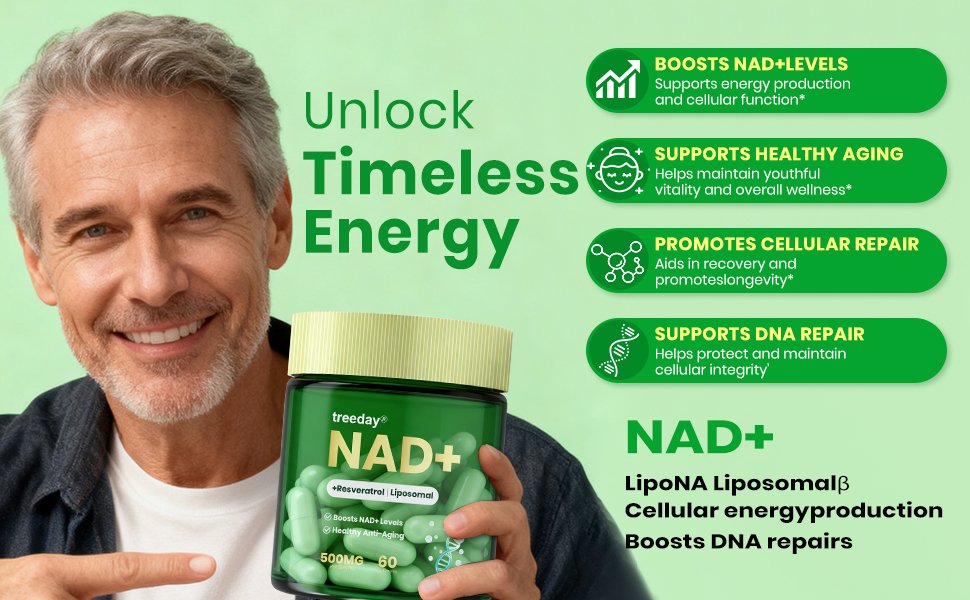
Now that you understand the importance of NAD+, the next step is finding an effective and reliable way to supplement it. TREEADAY is a brand dedicated to the field of anti-aging. Based on the latest research, we offer high-purity NAD+ precursor supplements, providing you with a convenient and effective solution for boosting your NAD+ levels.

Why Choose TREEADAY NAD+?

  • High-Purity Ingredients: We use premium Nicotinamide Riboside (NR) and Nicotinamide Mononucleotide (NMN) to ensure superior bioavailability.
  • Scientifically Optimized Formula: Our products combine NAD+ precursors with complementary ingredients to synergistically enhance synthesis efficiency.
  • Rigorous Quality Control: Our manufacturing processes meet international standards, guaranteeing both purity and safety.
  • Simple & Convenient: An easy, daily addition to your routine helps maintain healthy NAD+ levels, powering your cells for the long run.

Choose TREEADAY and make science-backed anti-aging a seamless part of your daily life. From understanding NAD+ to supplementing it, TREEADAY is with you every step of the way, fueling your cells and supporting your journey to lasting vitality.

Disclaimer: NAD+ supplements are dietary supplements and are not intended to diagnose, treat, cure, or prevent any disease. Please consult with a healthcare professional before starting any new supplement regimen.

Leave a Reply

Your email address will not be published. Required fields are marked *